• Why am I seeing low-quality adverts on FreeUKGenealogy websites?

    We've had a few people get in touch recently asking why some of the adverts they see on our websites don't seem very relevant, and in some cases feel a bit... low quality.

    The answer usually comes down to one simple choice: whether or not you accept personalised advertising via cookies.

    What's the difference?

    When you visit our sites, you're asked whether you're happy to accept cookies. One of the ways we use them is to allow our partners to determine which adverts you may see: in other words, whether or not you’ll receive personalised adverts. If you accept cookies, the ads you’ll see will be personalised ads, since you’ll enable advertisers to show you content based on your interests (for example, genealogy services, books, or things you've searched for elsewhere).

    If you decline cookies, you’ll still see ads, but advertisers are no longer able to tailor what you see.

    That second option is absolutely fine, and entirely your choice. However, it does have an unintended side effect.

    Why do the ads look worse?

    Advertisers try to show their ads to people who are likely to be interested. If personalisation is switched on, they can target those audiences more precisely.

    If personalisation is switched off, that targeting isn't possible. As a result advertisers will show ads “blindly”, i.e. the ads that appear are often more generic, or sometimes the kind of "clickbait" content many people dislike.

    So it's not that we are choosing to show poorer adverts. It's due to how the advertising ecosystem works behind the scenes.

    An example of a low-quality advertisement

    Why do we show ads at all?

    FreeBMD, FreeCEN, FreeREG, and (soon) FreePRO are free to use and always will be. However, keeping it free for you has a cost

    Advertising is our main source of income and helps us to:

    • keep the websites running
    • maintain and improve the data
    • support our volunteers and infrastructure

    Without it, we wouldn't be able to provide access to over 500 million records for free.

    At the same time, we know that advertising can affect how the site feels to use. We are committed to finding the right balance between generating the income we need and providing a good experience for our users. We are actively testing and finding ways to improve how adverts are displayed, with the aim of making them less intrusive while keeping our services sustainable.

    An example of a better quality advertisement

    What can you do?

    You are always in control of your preferences. If you are seeing adverts that feel irrelevant or poor quality, you may wish to review your cookie settings and consider allowing personalised ads. Many users find this results in more relevant and less intrusive advertising.
    If you prefer not to, that's completely fine too. We respect that choice, and we'll continue working to improve the experience as much as we can within those constraints.

    We’d love your feedback

    We are actively exploring ways to improve both the user experience and how advertising appears on the site. If you have thoughts, please do get in touch via the Contact form.

  • FreeBMD... but not as we know it?

    As you may know, FreeBMD is our largest project with over 25,000 visitors searching the database per week. Despite being the original website from 1998 (!), family history researchers clearly value the completeness of the database and its powerful search facility.

    For over a decade, Free UK Genealogy has been committed to refreshing our websites to make them more accessible to everyone in this modern age. The new FreeREG website was released in 2012 and FreeCEN followed in the summer of 2017; the enhancement of these sites offered improved readability, accessibility, and usability for all researchers.

    In the course of enhancing our systems across the three projects, we are revamping the much-loved FreeBMD website!

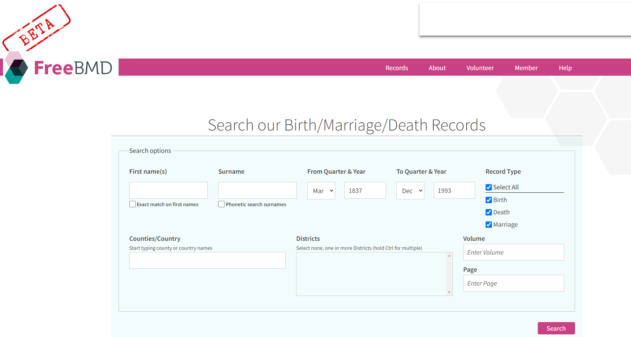
    We’re thrilled to share a teaser of the new FreeBMD search page, below. We hope you’re as excited as we are to try out the more intuitive, dynamic website; we’re sure it’ll help you take your family history research to the next level. 

    The new-look FreeBMD website. Look out for some useful new features...

    We expect the new FreeBMD website ("FreeBMD2") to be released for beta testing in 2025. As a volunteer-led charity, your donations and support have played a big part in helping us to reach this point. On behalf of everyone at FreeUKGEN and the wider genealogy community, thank you!

  • Brick Wall Challenge: Open Data Day 2020

    We have been inundated with responses so have closed for this year.

    ___________________________________________________

    We're holding a 'Genealo-thon' on Saturday the 7th March, using our records to help break down your brick walls.

    Why not get some fresh eyes on your Brick Wall Ancestor? This year for Open Data Day we're hosting a Brick Wall Challenge! Send us as much information as you have on your 'brick wall' ancestor (BWA) and the Free UK Genealogy community will try to help you push that ancestral line back a generation using our freely available Open Data.

    Use the form below to tell us as much as you can about your BWA and if your application is progressed we will be in touch!

    When sending us a FamilySearch tree link, please make sure the focus is on your brick wall ancestor, or other ancestor; if it is on yourself, we won't be able to view your tree.

    If you'd like to be involved from the other side, to help break down the Brick Walls, this is the page for you: https://www.freeukgenealogy.org.uk/news/2020/02/14/brick-wall-team/

  • Opening Death Data for Genealogists and Other Historians

    Open Data image with logos

    Open Data Day is an annual celebration of open data all over the world. On Saturday 3rd March groups from around the world will create local events on the day where they will use open data in their communities. It is an opportunity to show the benefits of open data and encourage the adoption of open data policies in government, business and civil society.

    All outputs are open for everyone to use and re-use.  Research Data is one of four themes for this year's Open Data Day.

    All three of our current projects contain information which is invaluable to family historians and other researchers. The indices to the registrations of death in England and Wales are, of course, freely available on www.freebmd.org.uk. Civil registration only started in 1837, so to find deaths which occurred earlier, you can look on www.freereg.org.uk, to see Church of England and other burials.  Later burials are there too, from the Church of England Registers and a growing range of religious organisations and secular bodies.  Most recently, we have received images of burial registers from Lancashire that are awaiting transcription - sign up here to help get them on line sooner!

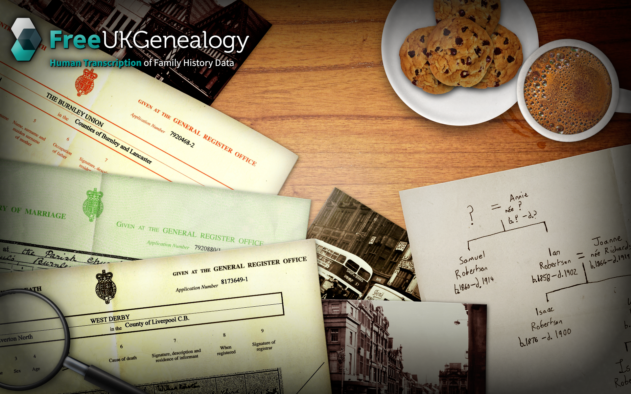
    Image of a desk with genealogy paraphernalia


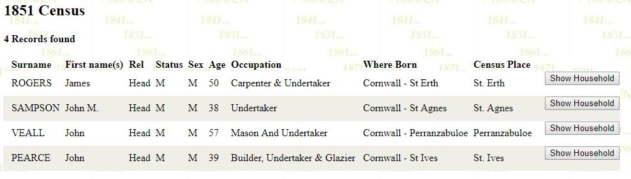
    Surprisingly, perhaps, the census records we transcribe and share on www.freecen.org.uk also have information about death. On https://freecen1.freecen.org.uk you can search by occupation, and this includes those who worked in various aspects of the businesses surrounding death.  Restricting the search to Cornwall, in 1841 there was just one (funeral) "undertaker" recorded (in St Austell) In 1851, four undertakers are recorded:

    Image showing details of four undertakers


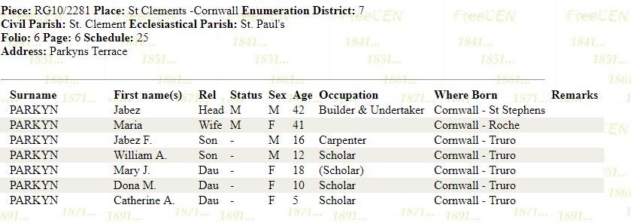
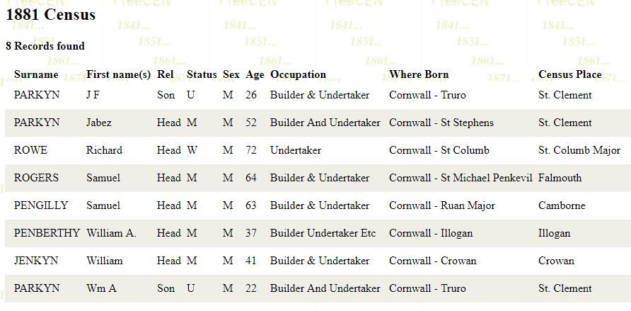
    In 1861, just one again is recorded, and in 1871 five including Jabez Parkyn.  A decade later, the Parkyn name becomes even more visible, as the children of the family (shown below in the 1871 census) continued the family trade, all three describing themselves as "Builder & Undertaker":

    1871 Census, Parkyn Family


    But in 1891, although the number had grown to 11, none of them was a Parkyn.  Jabez senior and Jabez junior (now spelled Parkin) are recorded purely as Builders, Jabez William A had become a painter.

    Parkin 1881 census


    This brief look raises many questions - many undertakers had more than one occupation (carpenter or mason being common).  Were others who were recorded only as masons or carpenters also arranging funerals? We have not yet enabled a search-by-occupation feature on FreeCEN2 - we'd love to know if you would use this feature, and how you would like the search of occupations to work there.

    I restricted the data to Cornwall, as we now have permission to share this dataset as Open Data - please contact us to request access to this dataset. Sharing this data as Open means that the history of undertaking in Victorian Cornwall can be undertaken (excuse the pun!) much more easily than for other counties.

    Please join us in exploring our records on 3rd March, commenting here or on our Facebook event.  We'd love to know anything you are doing with the data of death - for example if you are researching the Undertaking Parkyns of Cornwall, exploring longevity, or if you would like us to transcribe the records of your church or share the transcriptions from a graveyard survey.