Our data, new discoveries: how FreeBMD is helping researchers at the University of Cambridge
FreeBMD's records are helping researchers at the University of Cambridge tackle one of the biggest challenges faced when trying to trace people through history: how to identify married women from one census to the next.
The aim of the ‘Geolinking Project’ is to create links between people observed in different censuses, from 1851 to 1921, making it possible to build up a picture of their lives over time.
Once completed, it will enable researchers to better explore family histories and people's lives in the context of wider historical changes. But tracing women’s lives is particularly challenging for a number of reasons, and this is where FreeBMD comes in.
We spoke to Dr Alexis Litvine, project lead at the University of Cambridge, to learn more.
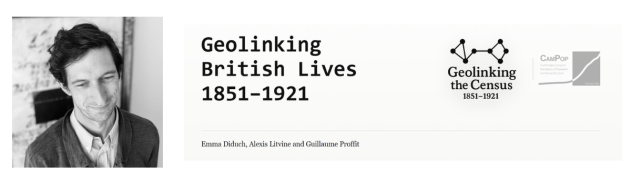
Dr Alexis Litvine, Geolinking Project Lead, University of Cambridge, UK.
What is your main challenge with tracing women from 1851-1921?
One of the most significant weaknesses of census linking methods to date has been their relative inability to link women between the ages of 15 and 30. This is mainly due to three factors:
First, women adopted their husband’s name. For us, the loss of such a crucial linking criterion is problematic to identify women across census periods since our method relied heavily on the names of the individuals.
Second, marriage also frequently led to a change in household for the bride and to varying degrees of migration, which reduces even further the contextual continuity between the two observations and makes linking even more complex.
Third, it also has a cultural dimension. Marriage reinforces an already present misreporting problem in the census, as it involves linking women using records filled out by their Head of Household (generally their father) to records written by their new husband. With this changing authorship comes an increased likelihood of misreporting their birthplace and other personal details.
Our solution to tackle the problem is to use the Marriage Index, as transcribed by FreeBMD, to establish additional links for women across marriage. By identifying potential husbands and wives from the same page of the index, we can then search for the woman under her maiden name in the previous census and compare details such as age and birthplace.
The main challenge for us lies in the structure of the source: as your readers will know, the Marriage Index does not list ‘marriage events’ but rather ‘marrying individuals’, making the identification of couples difficult.
Individual brides and grooms are listed separately and alphabetically under their names at the time of marriage, with the year, quarter and district in which their marriage entry was registered, and the relevant volume and page number of the civil registers in which the full marriage records can be found (which, however, have not been comprehensively transcribed and made available to researchers).
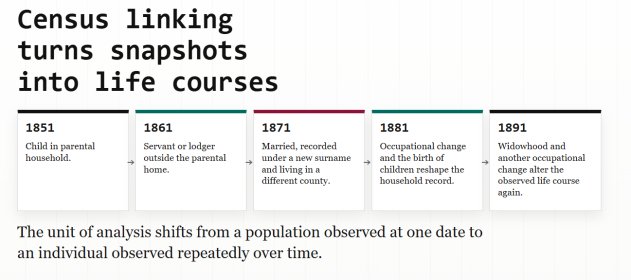
(Credit: Alexis Litvine, Emma Diduch and Guillaume Proffit)
In most cases, the given page of the original register contains two marriage entries – thus four individuals and eight possible couple combinations – but this varies slightly depending on the recording practice adopted at local registry offices across the country.
Despite these issues, most individuals can still be traced back to ‘standard’ pages containing four individuals, and around a tenth to pages containing only two individuals and thus one marriage.
The other challenge presented by the Marriage Index is the difference in name recording: index entries carry more official, verbose versions of names, often with (several) middle names or middle initials, whereas a census entry might have a single first name, or perhaps initials, nicknames and abbreviations.
Given how inaccessible the actual marriage entries themselves are, the Marriage Index nonetheless constitutes the most comprehensive source that can be used to improve linking of women across marriage.
Did the FreeBMD data help you achieve your project’s objective?
Yes. The curves in the graph below show how much of the dip in successful links for younger women (the red curve) we could sort out using the Marriage Index (the green curve). This is a significant improvement.
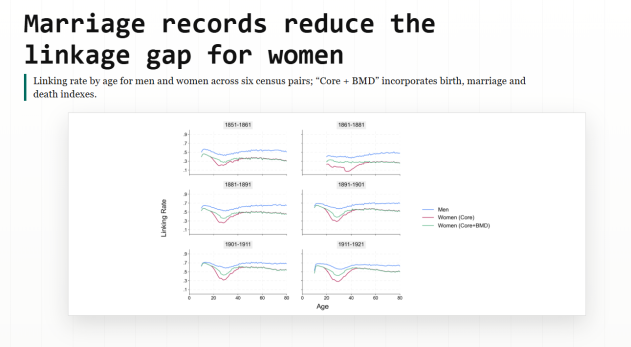
Marriage records reduce the linkage gap for women - GeoLinking Presentation (Credit: Alexis Litvine, Emma Diduch and Guillaume Proffit)
Thanks to our links, we will be able for the first time to reconstruct individual marriage and fertility timelines over long periods on a national scale and at a very high level of spatial disaggregation. Currently, the interaction between women’s work, marriage, and fertility cannot be satisfactorily studied because we cannot observe the occupational and household status of women before marriage and during their childbearing years.
We will now be able to identify the precise timing of marriage and dramatically improve our estimates of parity progression – the number and timing of children women have over their lifetimes – to study this phenomenon with unprecedented precision.
We will make all the links available to researchers, opening up many new possibilities for future projects and research questions and creating a fundamental new resource for British historians, economic historians, demographers, economists, sociologists, and many more. Our partners, genealogists, and the broader public will benefit from a much-enhanced ability to find data about their ancestors using our linked data.
We will also develop with secondary-school teachers ready-for-classroom pedagogical resources and lesson plans using our new data to improve the teaching of history and geography.
All of this is made possible by the work of the volunteers who have transcribed the records that make this research possible. The work of FreeBMD volunteers is helping researchers investigate questions about people's lives that could not previously be studied at this scale.
Will you require more data from us in the future?
We would love to! Any transcribed marriage or death certificates would be of a huge help for us.
How can we learn more about the project?
Please take a look at our website: https://geolinking.hist.cam.ac.uk
We are also looking for volunteers who have either done some linking themselves (either of a family or a place for the period 1851-1921). Anyone who has done this to a high quality can receive a copy of our links for the same sample so we can evaluate errors in our sample or the manually linked one.
Calling all researchers!
Free UK Genealogy welcomes enquiries from academic researchers and others undertaking research with a clear public benefit. More information here: https://www.freeukgenealogy.or...