Bringing the fallen back to life
How FreeBMD helped uncover the stories behind a school WW1 memorial
What can happen when you combine military records, civilian records and a little determination? For Scott Paget and a group of former pupils of John Lyon School in Harrow on the Hill, the answer is a comprehensive digital archive that brings the stories of their First World War fallen back to life – with FreeBMD playing an important part in its development.
From a brass plaque to a digital archive
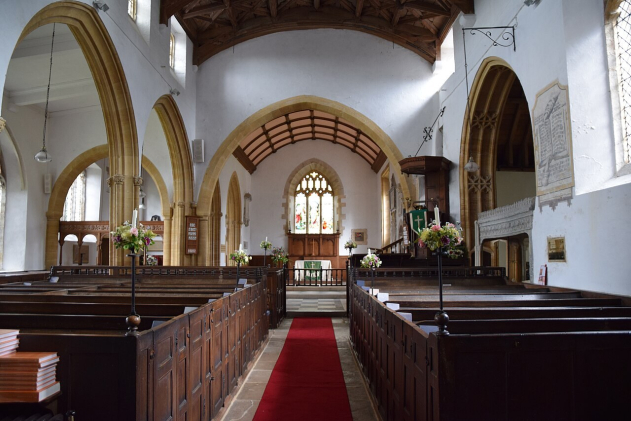
Scott, who had a brief volunteering spell with Free UK Genealogy as a programme manager earlier this year, was a pupil at John Lyon School between 1969 and 1974. He had wanted since 2019 to establish a permanent memorial to the school's fallen at St George's Memorial Church in Ypres, Belgium.
The opportunity came when the school celebrated its 150th anniversary and Scott's former classmates, the class of 1976, marked their 50th anniversary. At their annual dinner in April, the idea gathered momentum, with support from the school's Head, a historian, and the President of the Old Lyonian Association.
Donations from the class funded a brass plaque, but the project soon grew. The group decided to include a QR code on the plaque to enable visitors to discover the stories behind the names. This meant creating an online archive, and three members of the class stepped forward to help with military and civilian research. A researcher friend was also recruited to undertake civilian research. Other classmates contributed to the website, a video and even an original soundtrack.
Where FreeBMD came in
FreeBMD was an important resource for the civilian researcher, particularly in helping to locate birth records. These records provided valuable evidence when checking identities and establishing that the civilian and military records being brought together related to the same individual.
As Scott explains: "FreeBMD was a key tool for the civilian researcher, helping to uncover information about the men behind the military records. Where appropriate, it is cited in our research papers covering both military and civilian research. It's a comprehensive free resource, so a key tool where 'time' was the only consideration."
By combining military information with civilian records, the researchers could build a much fuller picture of the men being remembered: their families, their lives before the war and the communities from which they came.
Remembering the individuals
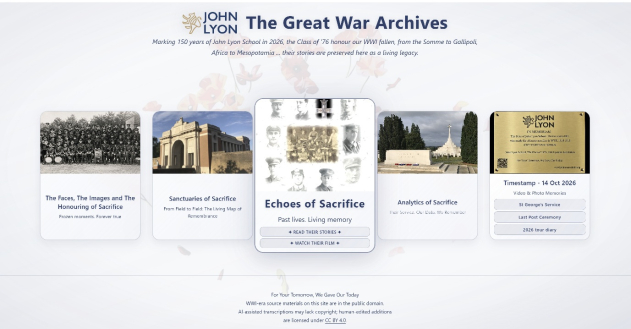
Now completed, The Great War Archive (TGWA) includes photographs, a map showing where former pupils are commemorated, military records, civilian research and individual stories. There are also videos about the school and its former pupils, recordings of the commemoration service and Last Post Ceremony, and memories of the group's visit to Ypres in October.
The QR code on the plaque provides a link between the physical and digital memorial. Visitors can scan it and discover the lives behind the names, turning a moment of remembrance into an opportunity to learn about the individuals being honoured.
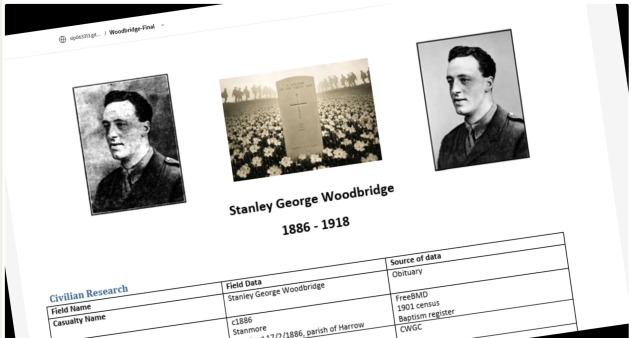
One example is the research into Stanley Woodbridge, whose story demonstrates how civilian and military records can be brought together to identify and understand an individual. FreeBMD is clearly referenced in the research, and its contribution can also be seen in the video produced as part of the project.
For Scott, the project has also brought together the class of '76, the school and the wider Old Lyonian community through a shared sense of purpose.
He believes that combining military and civilian records could have much wider applications, helping to tell the stories of those commemorated on memorials in villages and churches throughout the country.
A physical memorial is an important tribute, but it can only tell us so much. By linking it to accessible digital records, we can recover the lives, families and experiences behind the names. And, as Scott rightly says, these stories need to be kept alive.
Explore The Great War Archive: https://sip063313.github.io/TGWA/
Read Stanley Woodbridge's story: https://sip063313.github.io/TGWA/Woodbridge_Story.html